
Behind the Cheese | Week 9: What actually happens when cheese ages?
5th Nov 2026
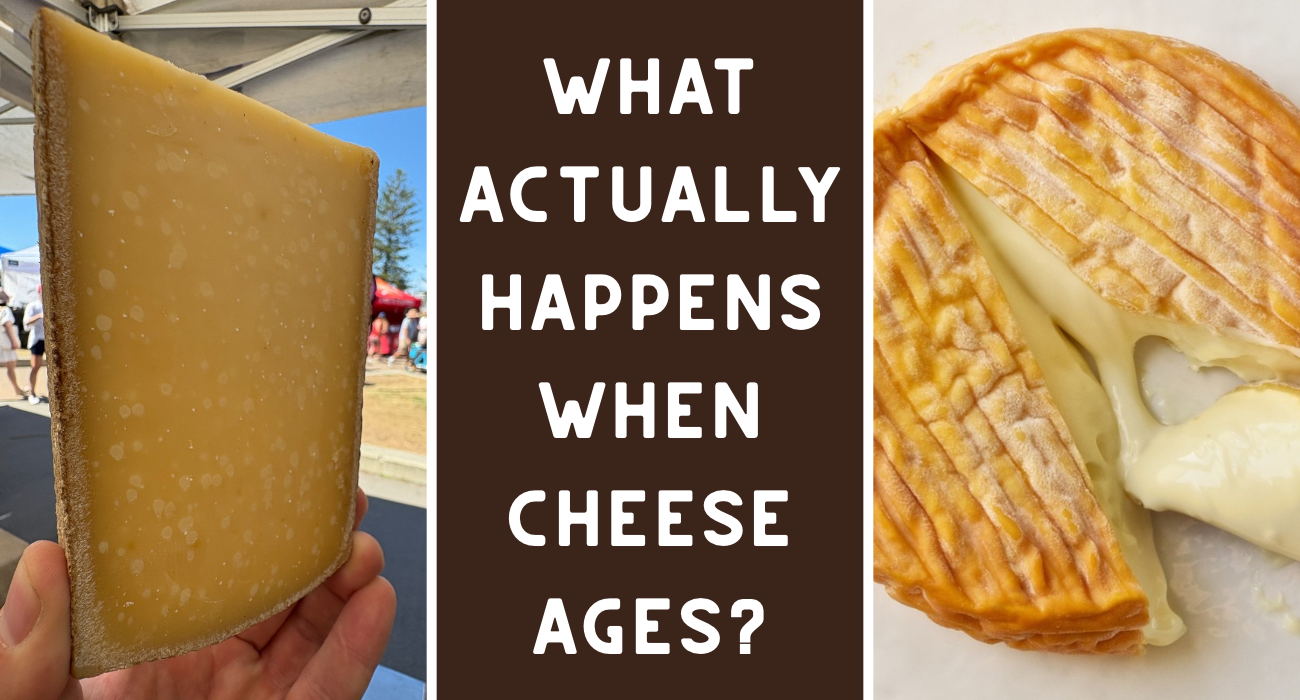
Cheese doesn’t simply sit in a cellar getting older. As it matures, it is constantly changing. Moisture moves out of the cheese. Proteins break down. Fats are transformed. Microorganisms continue working. The rind develops, and new flavour compounds appear.
All of these changes happen at different speeds depending on the style of cheese. That is why a young cheese can taste milky, mild and firm, while an older version of the same cheese may become nuttier, savourier, more aromatic, softer, firmer or even crystalline. Ageing is not just about time. It is about transformation.
The first big change: moisture loss
One of the most important things that happens during ageing is that cheese gradually loses water.
Fresh cheese contains a lot of moisture. As it sits in an ageing room, some of that moisture slowly moves from the inside of the cheese toward the surface and then into the surrounding air.
This affects the cheese in several ways. As water leaves, the cheese becomes firmer and more concentrated. Flavours can become more intense simply because there is less water diluting them. This is one reason a young hard cheese may taste relatively mild, while a much older version can seem far more concentrated and savoury. But moisture loss has to be controlled.
If a cheese dries too quickly, the rind may harden before the inside has matured properly. If it remains too wet, unwanted microorganisms may develop. This is why temperature and humidity in an ageing room matter so much.
Proteins begin to break down
One of the biggest changes in ageing cheese is called proteolysis. That sounds technical, but the idea is simple. Proteins in the cheese gradually break down into smaller pieces. This happens through the action of enzymes from the milk, rennet, starter cultures and microorganisms living in or on the cheese.
Proteolysis changes both texture and flavour. In some soft cheeses, it can make the paste turn creamy and almost liquid beneath the rind. In aged hard cheeses, it can help produce deeper savoury flavours. Over time, proteins are broken into peptides and amino acids. These smaller compounds can then contribute to flavours that might be described as nutty, brothy, meaty or umami-rich.
Why does Brie soften as it ages?
Brie is a great example of proteolysis in action. The white mould on the outside of the cheese produces enzymes. Those enzymes gradually move inward from the rind and break down the proteins in the paste. That is why a young Brie can be quite firm and chalky in the centre. As it matures, the area just beneath the rind becomes softer first. Over time, that softness moves toward the centre. This is a very different ageing pattern from a hard cheese like Comté or Parmigiano Reggiano. In Brie, the outside is driving much of the ripening.
Fats change too
Another important ageing process is called lipolysis. This is the breakdown of fats. As fats are broken into smaller compounds, they can create a wide range of aromas and flavours. Depending on the cheese, these may come across as:
-
buttery
-
creamy
-
sharp
-
spicy
-
fruity
-
mushroom-like
-
earthy
-
savoury
Blue cheeses are a good example. The mould inside the cheese is very active in breaking down fats, which is one reason blue cheese can develop such distinctive aromas and flavours.
Washed-rind cheeses can also develop powerful aromas through the combined activity of surface microorganisms and fat breakdown.
The rind keeps working
The rind is not just a wrapper around the cheese. In many cheeses, it is one of the most active parts of the ageing process. Bloomy-rind cheeses, washed-rind cheeses and natural-rind cheeses all have microorganisms living on their surfaces.
These moulds, yeasts and bacteria can change the chemistry of the cheese beneath them. They may soften the paste. They may help create aroma compounds. They may influence acidity. And they can affect how moisture leaves the cheese.
This is why two cheeses made from similar milk can develop completely different flavours depending on what is encouraged to grow on the rind.
Acidity changes over time
Cheese begins with milk, and during cheesemaking starter cultures convert lactose into lactic acid. This acidification is crucial. It helps control unwanted microorganisms, affects texture and influences how the curd behaves. But acidity does not remain exactly the same forever. As cheese ages, microorganisms continue to alter the chemistry of the paste and rind.
In some surface-ripened cheeses, acidity near the rind decreases as moulds and yeasts metabolise lactic acid. That changing acidity is part of what allows the paste to soften. So even something as simple as “how acidic is the cheese?” can change during maturation.
Why do aged cheeses become more savoury?
As proteins and fats break down, a greater variety of flavour compounds develops. Some of these contribute to what we often describe as savoury or umami flavour. At the same time, moisture loss concentrates what is already there. This combination helps explain why a long-aged cheese can taste much more intense than a young one. But “more intense” does not necessarily mean “better.”
Some cheeses are at their best when young and delicate. Others are specifically designed to mature for months or years. The ideal age depends on the style.
Where do those crunchy crystals come from?
One of the most enjoyable signs of ageing in some cheeses is the appearance of tiny crunchy crystals. These are not salt crystals in every case.
In long-aged cheeses such as Parmigiano Reggiano, Comté or aged Gouda, one common type is formed from the amino acid tyrosine. Tyrosine is released as proteins break down during ageing.
As the cheese continues to mature, it can become concentrated enough to form small crystals. Other cheeses can develop different types of crystals, including calcium lactate. These crunchy little pieces are often a sign that significant biochemical changes have taken place during ageing.
Why does cheese sometimes become crumbly?
As cheese loses moisture and its internal protein structure changes, texture can become firmer and more brittle. This is why long-aged hard cheeses often break into flakes or shards rather than bending smoothly. The protein network has changed. There is less moisture. And the cheese has become more concentrated.
So when an aged cheese crumbles apart, that texture is part of the maturation story.
Why do some cheeses become softer instead?
This is where ageing gets interesting. Ageing does not always make cheese harder. Surface-ripened cheeses can actually become softer as they mature. Brie, Camembert and many washed-rind cheeses are good examples.
Their surface microorganisms produce enzymes that break down the paste. So while moisture is still being lost, the protein structure is also being weakened. The result can be a cheese that becomes softer, creamier and more fluid with age.
That is why “older = harder” is not a universal rule.
The cellar matters
Ageing is not simply leaving cheese on a shelf. The environment has to be managed carefully. Temperature affects how quickly microorganisms and enzymes work. Humidity affects moisture loss and rind development. Airflow influences how quickly the surface dries.
Cheeses may also be:
-
turned
-
brushed
-
washed
-
rubbed
-
moved between rooms
-
checked for moisture
-
inspected for rind development
This is the work of affinage. The affineur is not just waiting for time to pass. They are actively guiding the cheese through maturation.
Why do some cheeses age for weeks and others for years?
Different cheeses are built for different ageing times. A small, high-moisture cheese may mature quickly. A large, dense wheel can take much longer. Salt content matters. Moisture matters. Size matters. The structure of the curd matters. And the microorganisms involved matter.
A soft goat cheese might reach its ideal point in a few weeks. A large Alpine cheese may continue improving for 12, 18 or 24 months. Some hard cheeses are designed to mature for several years.
The cheese itself determines the rhythm.
Does longer ageing always mean stronger flavour?
Often, but not always in the way you might expect.
With long ageing, some flavours become deeper and more concentrated. Sweet, nutty, toasted, caramelised or brothy notes may develop. Bitterness can also appear if a cheese is taken too far. Some aromas may become stronger, while others fade.
So ageing is not a simple straight line from mild to strong. It is a series of changes. A cheese can pass through several different flavour stages as it matures.
Can cheese be aged too long?
Yes.
Every cheese has an ageing window where its texture and flavour are at their best. That window can be narrow or very broad. If a cheese is kept too long, it may become overly dry, bitter, ammoniated or unbalanced. This is especially true with soft cheeses.
A perfectly ripe Brie can be beautifully creamy and mushroomy. Leave it too long, and the aroma can become dominated by ammonia and the texture may start to deteriorate. More time is not automatically better.
Good ageing is about knowing when the cheese is ready.
Ageing creates the cheese we recognise
When a cheese is first made, it often tastes very different from the final product.
Fresh curd can be mild, milky and relatively simple. Then ageing begins. Water moves. Proteins break down. Fats transform. Microorganisms reshape the rind and paste. Flavour compounds accumulate. Texture changes. And gradually, the young cheese becomes something recognisable.
This is why ageing is such a fundamental part of cheesemaking. For many cheeses, the work in the vat is only the beginning.
Time is only one ingredient
We often talk about a cheese being “12 months old” or “36 months old.” But age alone does not explain what makes it good.
Two cheeses aged for the same length of time can taste completely different. The milk matters. The cultures matter. The rind matters. The humidity matters. The temperature matters. And the decisions made by the cheesemaker and affineur matter. Age gives those processes time to work. But it is what happens during that time that truly transforms the cheese.
So next time you taste an aged cheese, think about everything that happened between fresh curd and the piece in front of you. Because cheese ageing is not simply waiting. It is a slow, controlled transformation — one that can take weeks, months or even years.