
Behind the Cheese | Week 10: Why do some cheeses have holes?
11th Nov 2026
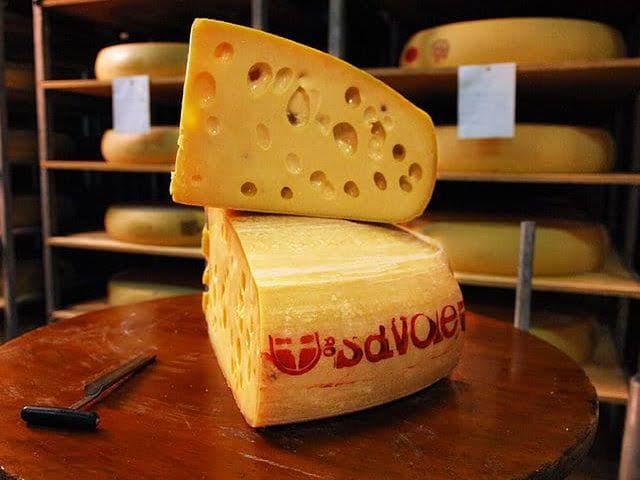
Holes are one of the most recognisable features in cheese. Think of a classic wheel of Emmental with its large, round openings. Those holes are so iconic that they have almost become shorthand for “cheese” itself. But not all holes are the same. Some are created by gas produced during fermentation. Others are simply spaces left behind when curds are pressed together. And depending on the cheese, the size, shape and number of holes can tell you quite a lot about how it was made. So what is actually happening inside the cheese?
The proper name is “eyes”
In cheeses such as Emmental, the holes are usually called eyes. These eyes form during maturation when certain bacteria produce carbon dioxide gas. Because the cheese paste is dense, the gas cannot escape easily. Instead, it gathers in small pockets. As more gas accumulates, those pockets expand and become the round holes we see when the cheese is cut. So the eyes are essentially little bubbles of gas trapped inside the cheese.
Where does the gas come from?
The carbon dioxide is produced by bacteria involved in the fermentation and ageing process. In traditional Swiss-style cheeses, bacteria from the Propionibacterium group play an important role. These bacteria feed on compounds already present in the cheese and produce several by-products. One of those is carbon dioxide.
As the cheese matures, the gas gradually collects. At the same time, those bacteria also contribute to the characteristic sweet, nutty and savoury flavours associated with cheeses such as Emmental. So the holes and flavour development are connected to the same biological activity.
Why are the holes so round?
Gas pushes outward in every direction. If the cheese paste is soft and elastic enough, the pressure creates smooth, rounded pockets. That is why classic eyes tend to look circular or oval rather than jagged.
The texture of the cheese is important. If the paste were too firm or brittle, the gas would not be able to expand in the same way. So cheesemakers need the right balance of moisture, elasticity and fermentation for proper eye development.
Why are some holes bigger than others?
Several factors influence the size of the eyes. These include:
-
the bacterial cultures used
-
the temperature during ageing
-
the amount of moisture in the cheese
-
the elasticity of the paste
-
the amount of gas produced
-
how long the cheese is matured
Warmer ageing conditions can encourage certain bacteria to become more active. More bacterial activity can mean more gas. That can lead to larger eyes. But cheesemakers do not simply want the biggest holes possible. The size, shape and distribution of the eyes are part of the desired style of the cheese.
Why does temperature matter?
Many Swiss-style cheeses go through different stages of maturation. After the cheese is made and pressed, it may initially be kept relatively cool. Later, it can spend time in a warmer ageing room. That warmer period encourages the gas-producing bacteria to become more active. As they work, carbon dioxide builds up inside the cheese and the eyes begin to form. The cheese may then be moved back into cooler conditions for slower maturation. So temperature is being used as a tool to guide what happens inside the wheel.
Why don’t all cheeses form eyes?
Because not all cheeses contain the same bacteria or have the same structure.
A Brie, for example, is designed to ripen from the surface inward. A cheddar is made using a very different process. A blue cheese needs an open structure so oxygen can travel through the paste. Each cheese is built for a particular type of maturation.
For eye formation, the cheese needs the right bacteria, the right moisture and the right texture. Without that combination, gas either is not produced or does not form large, visible pockets.
Are all holes caused by gas?
No. This is where things get interesting. Some cheeses contain small irregular openings that are not true eyes at all. These spaces can simply be gaps left between curds during moulding and pressing. When curds are placed into a mould, they may not fit together perfectly. If some air remains between them, little openings can remain in the finished cheese. These are often called mechanical openings. They tend to look less smooth and less round than true fermentation eyes.
Eyes versus mechanical openings
A true eye is created by gas pressure. It usually has smooth sides and a fairly rounded shape. A mechanical opening is created by the way curds fit together. It often looks more irregular. Both can appear in perfectly good cheese. They simply tell different stories about how that cheese was made.
Why do blue cheeses have so many openings?
Blue cheese is a special case. Its internal openings are extremely useful. Blue mould needs oxygen to grow. That is why blue cheeses are often made with a relatively open structure. Small spaces between the curds create pathways for air. When the cheese is pierced with needles, oxygen can travel through these openings. The mould then grows along those channels. So in blue cheese, irregular openings are not a defect. They are part of the design.
Can holes be a defect?
Sometimes. In certain cheeses, unwanted gas production can create openings where none should exist. That can happen if undesirable bacteria become active during production or ageing. The result might be cracks, splits or irregular holes. This is one reason cheesemakers carefully control milk quality, cultures, temperature, salt and hygiene. In one cheese, gas production is essential. In another, it can be a serious problem. Context matters.
Why were holes historically important?
Before modern laboratory testing, cheesemakers relied heavily on sight, smell, touch and experience.
The appearance of a cheese could reveal a lot about how fermentation had progressed. The size and distribution of eyes could indicate whether the bacterial activity had developed correctly. Even today, eye formation is still an important quality characteristic in many traditional cheeses. A well-made Emmental is not simply expected to contain holes. The holes should have the right shape, size and distribution for the style.
Do holes affect flavour?
Indirectly, yes. The bacteria responsible for eye formation also contribute to flavour development. In Swiss-style cheeses, they help create sweet, nutty and slightly fruity notes. So the eyes themselves do not create flavour. They are a visible sign that certain fermentation processes have taken place. The same microorganisms that make the gas also help shape the taste.
Does more holes mean more flavour?
Not necessarily. A cheese with more eyes is not automatically stronger or better. Eye formation is only one part of the maturation process. Flavour also depends on:
-
milk quality
-
cultures
-
salt
-
moisture
-
ageing time
-
rind development
-
temperature
Two cheeses with similar-looking holes can taste very different. And two wheels of the same cheese may develop slightly different eye patterns.
Why do some cheeses have tiny eyes?
Some cheeses contain very small, evenly distributed holes rather than large round eyes. This can happen because less gas is produced, or because the paste is firmer and does not allow large pockets to expand. The cheesemaking method can also leave tiny openings between curds. So small holes may come from fermentation, mechanical structure or a combination of both.
Cheese holes are a map of fermentation
When you cut into a cheese with eyes, you are looking at a record of what happened during maturation. Bacteria produced gas. The paste stretched. The gas collected. Temperature influenced the process. And over time, little pockets formed inside the cheese. Those holes are therefore not empty space. They are evidence of biological activity.
Not every hole tells the same story
A round, smooth eye in Emmental and an irregular opening in blue cheese may look similar at first glance. But they were created for completely different reasons. One comes from gas produced during fermentation. The other comes from the physical structure of the curd. That difference is part of what makes cheese so fascinating. The inside of a wheel can reveal just as much as the rind on the outside.
So next time you cut into a cheese and see a hole, take a closer look. Is it smooth and round? Irregular and open? Tiny and scattered? You may be looking at a clue to exactly how that cheese was made.