
How to: Hosting a Cheese Tasting Night
30th Jul 2026
How to Host Your Own Cheese Tasting Night
If there's cheese in your fridge right now (and let's be honest, there probably is), you already have everything you need to turn a Friday night into something special. A cheese tasting night isn't about fancy equipment or formal training — it's about slowing down, paying attention, and actually noticing what's in front of you. Here's how to do it properly.
Step 1: Get Your Cheese Ready
The single biggest mistake people make is serving cheese straight from the fridge. Cold cheese is muted — the flavours haven't woken up yet, and the texture can be dry, rubbery or crumbly in all the wrong ways. Pull your cheeses out 30–60 minutes before serving so they can come up to room temperature. This alone will transform the experience.
While you wait, set your table:
- A separate knife for each cheese (no cross-contamination of flavours)
- Clean plates or a board for each guest
- Something to cleanse the palate between cheeses — plain water crackers, a little sourdough, apple slices, or still water all work well
- Notepads or index cards if you want guests to jot down their impressions
Step 2: Choose Your Cheeses
A good tasting board has variety in milk type, texture and intensity — and a sense of progression. For a well-rounded five-cheese line-up, we'd suggest something like this:
- Comté — a firm, nutty cow's milk cheese to open the evening gently
- Ossau-Iraty – a sheep's milk cheese from the Pyrenees, slightly firmer and more savoury
- Bûche de Chèvre — a fresh, tangy goat's log that shifts the palate into brighter, more acidic territory
- Époisses — a wonderfully pungent washed-rind cheese that needs a spoon as much as a knife
- Roquefort — finishing on the boldest note, a classic French blue with plenty of punch
The golden rule: taste from mildest to strongest. If you start with the Roquefort, nothing after it will stand a chance.
Step 3: Actually Taste the Cheese
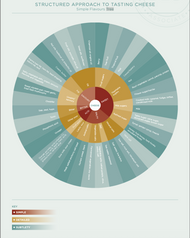
This is the part most people skip — and it's the most rewarding. Rather than just eating, try walking through each cheese in three stages.
Look and touch first. Before anything goes in your mouth, look at the rind — is it natural, waxed, washed, or ash-coated? Then look at the paste (the interior) — soft and spreadable, or firm and crumbly? Texture tells you a lot about what's coming.
Smell it next. Hold the cheese away from your nose and slowly bring it closer, noting when the aroma first becomes noticeable — that tells you its intensity. Then smell the rind specifically for any sharp, ammonia-like notes, which can indicate a very ripe cheese. Beyond that, see what else you can pick up: earthy, floral, fruity, or mineral notes are all common.
Then taste — slowly, and in two waves. As the cheese first hits your tongue, you'll notice simple flavours: sweet, salty, sour, bitter, and savoury (umami). These fade quickly, giving way to more complex flavours that build as you chew and breathe out through your nose — things like grassiness, fruitiness, nuttiness or mushroomy depth. Give each cheese a few seconds of quiet attention before moving on to the next.
Step 4: Talk About It
Cheese tasting is more fun — and more memorable — with company. Encourage your guests to describe what they're noticing out loud. Everyone's palate is a little different, and comparing notes helps you all pick up on flavours you might have otherwise missed. Simple prompts help:
- What's the first flavour you notice?
- Does anything change the longer you chew?
- Does the smell match the taste, or surprise you?
Step 5: Pair Thoughtfully
A simple French-leaning pairing works beautifully with the board above — a crisp white Burgundy with the Comté, something light and fresh for the Bûche de Chèvre, and a classic Sauternes alongside the Roquefort to play off its saltiness. If wine isn't your thing, a good cider or even sparkling water with citrus does the job of cleansing the palate between cheeses.
Keep It Simple
You don't need formal training to run a proper tasting — just curiosity, a little patience, and cheese that's been given the chance to come alive at the right temperature. The more you taste this way, the more your palate sharpens, and the more you'll notice in every board that follows.
This guide draws on the structured tasting approach taught by the Academy of Cheese, adapted here for a relaxed evening at home.
Ready to build your board? Pop into Le Fromage Yard for Comté, Ossau-Iraty, Bûche de Chèvre, Époisses, Roquefort, and everything else you'll need for a night to remember.