
The Complete History of Fondue: From Alpine Survival Food to the World's Most Beloved Shared Meal
4th Jun 2026
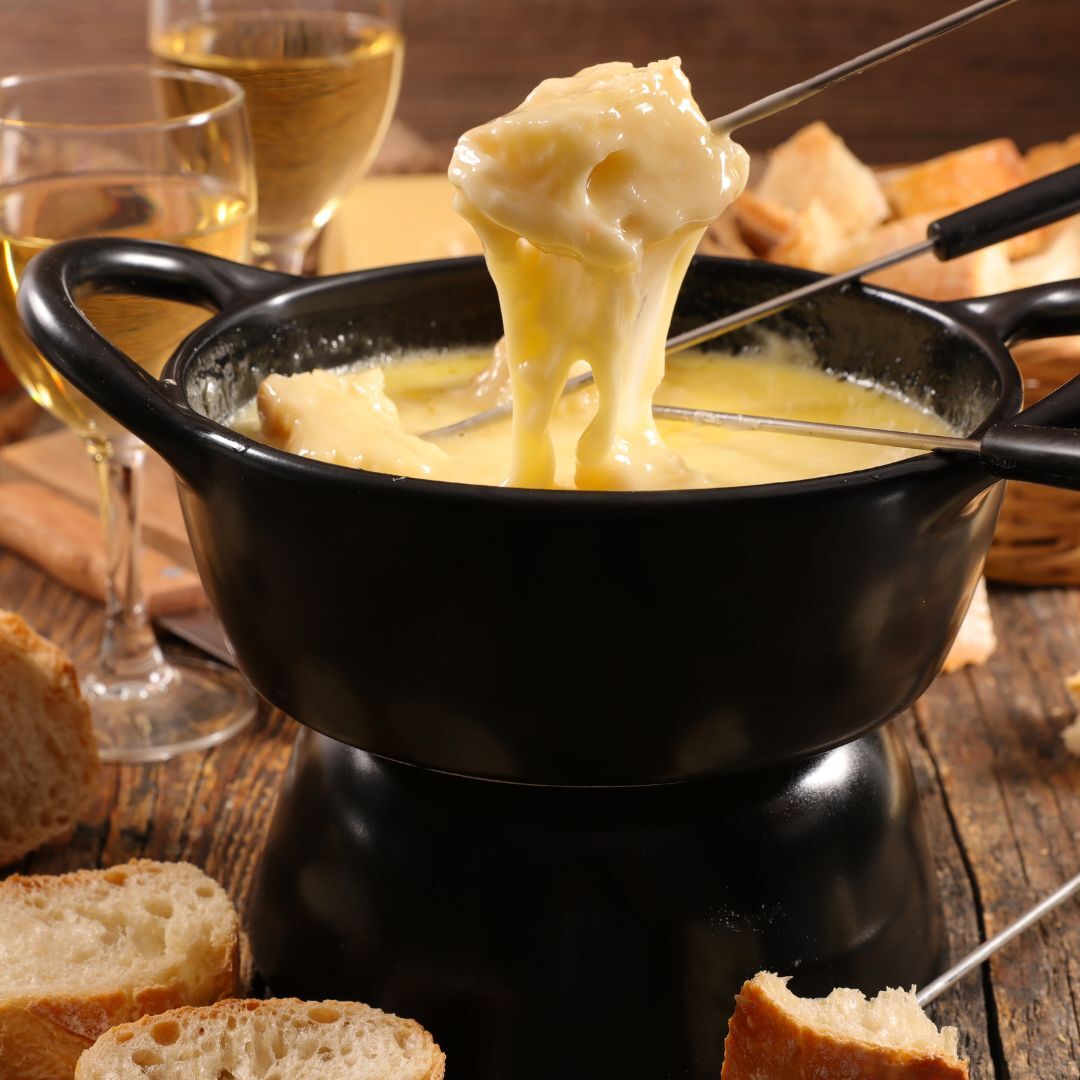
There are few dishes in the world that command a table the way fondue does. The pot arrives at the centre, steam rising, cheese molten and glossy, and something changes — conversation slows, people lean in, forks are raised. It is communal in the truest sense. But how did a pot of melted cheese and stale bread become one of the most iconic dishes in culinary history? The answer stretches back centuries, winds through Swiss mountain villages, survives a world war, gets hijacked by a cheese cartel, and eventually ends up as a dinner party staple from Brisbane to Brooklyn.
This is the full story of fondue — and it is far more extraordinary than you might expect.
Part One: In the Beginning — Melting Cheese to Survive Winter
The Swiss Alps in the eighteenth century were not a place of abundance. Villages were isolated by snow for months at a time, and the rhythm of survival was dictated entirely by the seasons. Cheese and bread were made in the warm months — and then had to last through the cold.
By midwinter, the situation was stark. The bread baked weeks earlier had turned rock-hard. The wheels of cheese in the cellar were drying out, growing rinds too thick to eat easily. Wine from the previous harvest sat in barrels. Families faced a choice: waste what they had, or find a way to make it edible.
The solution was devastatingly simple. Place a pot over the fire. Add wine. Melt the cheese into it. Dip the stale bread. The heat of the wine softened the bread, the fat of the cheese made it rich, and the garlic and herbs that Alpine cooks invariably threw in transformed the whole thing into something genuinely wonderful.
This was not a recipe invented in a professional kitchen. It was a practical act of necessity by farm families who could not afford to throw anything away. And yet, what they created was one of the most pleasurable eating experiences in the world.
The Earliest Written Evidence
The earliest known reference to something resembling cheese fondue comes from Homer's Iliad, written around 800 BC, which describes a mixture of goat's cheese, wine, and barley flour served as a meal — though this is more of a curious historical footnote than a direct ancestor.
The first written recipe that genuinely resembles modern fondue appears in a 1699 Zurich cookbook, published under the delightful title Käss mit Wein zu kochen — literally, "to cook cheese with wine." The recipe calls for grated or cut cheese melted with wine, and is recognisably the dish we know today. Importantly, it specifies Gruyère — firmly establishing the Swiss origin of the recipe despite later French claims to the dish.
By the early eighteenth century, fondue was appearing in French and Belgian cookbooks as well — but these recipes also called for Gruyère, which only strengthened Switzerland's claim as the true homeland of fondue. The French word fondre, meaning "to melt," gave the dish its name, and by the mid-eighteenth century, fondue had settled as the standard term across the region.
Part Two: The Science of the Perfect Melt — and a 1905 Revolution
For much of its early history, fondue had a problem. Melting cheese into wine produces a separated, greasy, stringy mess as often as it produces a smooth, silky pot. The chemistry of cheese — fat, water, and proteins — is not naturally inclined toward a uniform emulsion when heated. Many early versions of fondue would "break," with the fat separating from the protein in an unappetising puddle.
The breakthrough came in 1905, when cornstarch was introduced to Switzerland from the Americas. A small amount of cornstarch mixed into the cheese before melting acts as a stabiliser, binding the fat and protein together and producing the famously smooth, elastic consistency we now associate with a well-made fondue. This single culinary innovation made the dish reliably reproducible and opened the door to its wider adoption.
The addition of Kirsch — cherry brandy, a Swiss staple — also served a practical purpose: the alcohol in the spirit helped prevent the cheese from seizing, while the sweetness of the cherry spirit balanced the acidity of the wine. These were not arbitrary flavour choices. They were the result of generations of cooks learning, through trial and error, how to make the chemistry work.
Part Three: The Swiss Cheese Union and the Making of a National Myth
Here is where fondue's story takes an unexpected and rather remarkable turn.
By the 1930s, Switzerland was facing an agricultural crisis. The dairy industry, which underpinned the economy of much of the country, was in trouble. The Swiss Cheese Union — Schweizerische Käseunion — was formed to stabilise the industry, and it did so through methods that would be recognisable to any modern marketing executive.
The Union decided that Switzerland needed a national dish. It needed a symbol — something that conveyed warmth, community, and Swiss identity. Fondue, the humble Alpine survival food, was elected for the role.
What followed was one of the most effective food marketing campaigns in history. The Swiss Cheese Union promoted fondue relentlessly as the national dish of Switzerland, the embodiment of Swiss Gemütlichkeit — that untranslatable German concept of cosiness, belonging, and good cheer. They created regional "authentic" recipes, each tied to a specific Swiss canton. They embedded fondue into Swiss military cookbooks, ensuring every soldier knew how to make it. They sent fondue sets to military regiments, to event organisers, to embassies. The slogan Fondue isch guet und git e gueti Luune — "Fondue is good and creates a good mood," often shortened to the acronym FIGUGEGL — became a kind of rallying cry.
The campaign worked beyond anyone's expectations. By the mid-twentieth century, fondue was Switzerland — indistinguishable in the popular imagination from the Alps, cowbells, and precision watchmaking.
The Darker Chapter
The Swiss Cheese Union's story does not have an entirely happy ending. The organisation, which had operated for over eight decades, was eventually discovered to have been running what was essentially a financial cartel — fixing milk prices, limiting production to approved varieties, and engaging in widespread corruption and fraud. The Union was disbanded in the 1990s amid scandal, and its collapse allowed a new generation of independent cheesemakers to flourish.
But by then, fondue had escaped. It no longer needed the Union's marketing machine. It had taken on a life of its own.
Part Four: Fondue Conquers the World — New York, 1964
For all the Swiss Cheese Union's domestic success, fondue remained largely unknown outside Europe until the 1960s. The catalyst for its global spread was the 1964 World's Fair in New York City.
Switzerland's pavilion at the Fair featured fondue prominently — and American visitors were captivated. Here was a dish that was theatrical, interactive, social, and deeply different from anything in the American culinary repertoire. The combination of novelty, European sophistication, and sheer deliciousness proved irresistible.
Within a few years, fondue sets had become a staple of American households. By the 1970s, the fondue party was a cultural institution — as much a feature of suburban entertaining as the avocado-green kitchen and the station wagon. Every housewares store sold fondue sets. Every host owned one.
The fad, as fads do, eventually passed. By the 1980s, fondue had retreated from the mainstream. But it never truly disappeared — and in recent years, driven partly by a broader renaissance of interest in communal, slow-food dining, it has returned with renewed enthusiasm. In Brisbane's winter months, the appeal is self-evident.
Part Five: The Regional Variations — Switzerland, France, and Beyond
One of the things the Swiss Cheese Union did — for better or worse — was create "authentic" regional fondue recipes where few had existed before. But genuine regional variation in fondue does exist across Switzerland and into France, and understanding these differences is part of understanding the dish.
Fondue Fribourgeoise (Canton of Fribourg, Switzerland)
Perhaps the most distinctive of the Swiss regional styles, fondue fribourgeoise uses only Vacherin Fribourgeois — no Gruyère, no wine. The result is a fondue made purely with water (sometimes a small amount of white wine or Kirsch) and this single, creamy, gentle cheese. It is softer, milder, and more yielding than the classic version — some describe it as the most comforting of all fondues. The canton of Fribourg is fiercely proud of this distinction.
Fondue Moitié-Moitié — "Half and Half" (Switzerland)
The most famous and widely replicated Swiss style is moitié-moitié — half Gruyère, half Vacherin Fribourgeois — created to unite the two great cheese traditions of western Switzerland. This is the version most people encounter in Swiss restaurants and the one most often referred to as "classic fondue." The Gruyère provides structure, nuttiness, and depth; the Vacherin Fribourgeois provides creaminess and a gentle, washed-rind character. Dry white wine (traditionally Fendant, from the Valais region) and a splash of Kirsch complete the pot.
Fondue Neuchâteloise (Canton of Neuchâtel, Switzerland)
Named for the French-speaking canton on the shore of Lake Neuchâtel, this version uses a blend of Gruyère and Emmental, with white wine from the local Neuchâtel appellation. The Emmental adds a milder, sweeter, slightly nutty character alongside the Gruyère's depth, and the Neuchâtel wine — crisp, dry, with good acidity — helps keep the pot silky.
Fondue Valaisanne (Valais, Switzerland)
The Valais is Switzerland's great wine canton, and the fondue valaisanne reflects this. It typically features Raclette cheese — which is to say, the cheese from which the dish of the same name is made — melted with Fendant wine. The result is deeply savoury, slightly pungent, and intensely satisfying. Some versions also incorporate local dried herbs or a pinch of paprika.
Fondue Savoyarde (Savoie, France)
Cross the border into the French Alps and you enter the domain of fondue savoyarde — the great French contribution to the canon. This uses three cheeses native to the Savoie region: Beaufort (a magnificent, complex mountain cheese with a slightly sweet, long-aged character), Comté (the great aged cheese of the Jura, with its trademark notes of toasted hazelnut and brown butter), and Abondance (a semi-firm, amber-rinded mountain cheese with a gentle fruitiness). These are melted together with a dry Savoie white wine such as Apremont or Jacquère, and often finished with a splash of Kirsch. The result is arguably the most complex-tasting of all fondues — three distinct cheeses, each bringing something different to the pot.
Fondue au Comté (Franche-Comté and Jura, France)
A simpler but no less distinguished French style, this fondue uses Comté alone — or sometimes Comté with a small addition of Morbier, the Jura cheese distinguished by its ash layer. The wine used is typically Savagnin or Chardonnay from the Jura appellation. Comté's character — the sweetness of mountain milk, the complexity of extended ageing, those hazelnut and caramel notes — translates beautifully into a fondue that is at once luxurious and refined.
Fondue Bourguignonne — A Different Beast Entirely
Worth mentioning because it is so often conflated with cheese fondue, fondue bourguignonne is not actually a cheese dish at all. It is cubes of beef or other meat cooked in a communal pot of hot oil at the table — a concept credited to Swiss restaurateur Konrad Egli, who introduced it to New York in 1956 at his Chalet Suisse restaurant. The name is something of a misnomer (it has little connection to Burgundy), but the format — communal pot, long forks, shared experience — is unmistakably from the same family.
Part Six: What to Eat With Fondue — The Complete Guide
The classic accompaniment to cheese fondue is, of course, bread — specifically, a rustic, slightly stale loaf (the staling matters; fresh bread tends to fall apart in the pot). A crusty baguette, a sourdough boule, or a Swiss-style bread are all excellent. Cut it into cubes of roughly three centimetres — small enough to be one bite, large enough to hold its shape on the fork.
Beyond bread, the world of fondue accompaniments is broader than many realise.
Vegetables: Blanched broccoli and cauliflower florets, baby potatoes (boiled until just tender), carrot sticks, celery, and roasted mushrooms all work beautifully. The cheese clings to their surfaces and the vegetable provides a counterpoint to the richness of the pot.
Charcuterie: Thin slices of air-dried beef (Bündnerfleisch in the Swiss tradition), prosciutto, and salami all work well alongside — or even dipped into — the pot.
Pickles and acidity: Cornichons and pickled onions are traditional for a reason. The sharpness cuts through the fat and resets the palate between bites. A small green salad dressed with a sharp vinaigrette performs the same function. Do not skip the acidity — without it, the richness of the cheese becomes overwhelming.
Apple slices: A less traditional but genuinely excellent pairing. The sweetness and tartness of apple alongside melted Gruyère is a combination that works on every level.
Finishing touches: A grating of fresh black pepper over the pot before serving is non-negotiable. A pinch of nutmeg is classical. And if you want to elevate the experience further, reach for a jar of Piment d'Espelette — a small dusting of the Basque chilli over the finished pot adds a fruity, gentle heat that is quite extraordinary.
The Rules (Take Them as Seriously as You Like)
Traditional Swiss fondue etiquette holds that if you drop your bread into the pot, there are consequences. In some traditions, the offender must buy a round of drinks. In others, they must sing a song. In the most exacting Fribourgeois households, dropping your bread twice means washing the dishes. The precise penalty matters less than the spirit: fondue is a game as much as a meal, and the rules are part of the fun.
Stir in a figure-eight pattern to keep the pot smooth and prevent sticking. Keep the heat low and steady — a rolling boil will cause the fondue to break. And rub the pot with a cut clove of garlic before adding anything else. This is not optional.
The Crispy Bottom — La Religieuse
Every great fondue ends the same way: as the pot empties, the last remnants of cheese on the base of the caquelon are allowed to caramelise into a crispy, slightly browned crust. This is called la religieuse — "the nun" — and is considered the best part of the meal. Peel it off in one piece, divide it among the table, and eat it as is. It is salty, concentrated, and intensely good.
If you have never had la religieuse, you have never truly finished a fondue.
The Cheeses at Le Fromage Yard for Your Winter Pot
We carry the cheeses you need to make a fondue worth talking about. Here is what we recommend, and how to use them.
Gruyère AOP — The essential backbone. Rich, nutty, complex, and beautifully melting. Use this as your base in any style of fondue. Aged 12+ months for depth of flavour.
Vacherin Fribourgeois — The creamy counterpart. Supple, gently pungent, and extraordinarily smooth when melted. Combine with Gruyère for the classic moitié-moitié, or use alone for the fribourgeoise style.
Comté AOP — The French prestige option. Toasted hazelnut, sweet milk, long complexity. Use in a fondue savoyarde alongside Beaufort and Abondance, or simply on its own with a good Jura white wine.
Raclette — The melting cheese of the Valais. Less commonly used for fondue but magnificent when it is — deeply savoury, with a character that is impossible to replicate with anything else.
Come and see us, or order online — we will help you find exactly what you need for your pot this winter.
A Simple Classic Fondue — The Recipe
Serves 4 generously
What you need:
- 400g Gruyère AOP, grated
- 200g Vacherin Fribourgeois, grated
- 1 clove garlic, halved
- 300ml dry white wine (a Swiss Fendant, or any crisp, dry white)
- 1 tablespoon cornstarch
- 2 tablespoons Kirsch
- A grating of nutmeg
- Freshly ground black pepper
- Crusty bread to serve
The method:
Rub the inside of your fondue pot (caquelon) thoroughly with the cut garlic, then discard the clove. Pour in the wine and bring to a gentle simmer over medium heat.
Mix the cornstarch with the Kirsch in a small bowl until smooth.
Add the grated cheese to the wine in three stages, stirring constantly with a wooden spoon or heatproof spatula in a figure-eight pattern. Allow each addition to melt fully before adding the next.
Once all the cheese is incorporated, add the cornstarch mixture and stir for a further two minutes — the fondue will thicken and become glossy.
Season with nutmeg and black pepper. Transfer to your burner at the table and keep at the lowest heat that maintains a gentle simmer.
Dip, swirl, eat. Do not lose your bread.